Roofing CRM & Marketing Systems Built for Contractors
Track leads, follow up on estimates, manage roofing jobs, improve local search visibility, and keep customers updated from first call through final payment.

Roofing
A roofing company can lose money long before the crew ever gets on the roof. An estimate sits without a follow-up. An insurance lead doesn't hear back. A homeowner isn't sure when the crew is arriving. A finished customer never gets asked for a review. North & Nova builds the systems around those steps so opportunities turn into sold and paid work.
How We Build & Run This System
We start by looking at how work moves through your business today: where inquiries come in, how fast they get answered, what happens to a quote after it goes out, and where jobs stall. Then we replace the manual steps that depend on you with automated ones that do not.
Every piece is set up around your real service areas, your trade, your pricing, and your schedule. We handle the technical setup, the carrier registration for business texting, the dispatch calendar, and the review campaigns so your team can stay on the work in the field.
Once it is running, you can see where every lead came from, which quotes are sitting open, and where revenue is being lost. That visibility is what lets you fix the next leak instead of guessing at it.
Close more high-ticket roofs with a dedicated roofing CRM and marketing system.
One System From Roofing Lead to Completed Job
A roofing company can lose money long before the crew ever gets on the roof. An estimate sits without a follow-up. An insurance lead doesn't hear back. A homeowner isn't sure when the crew is arriving. A finished customer never gets asked for a review. A strong roofing company can still lose work because the steps between inquiry and completed job aren't connected.
North & Nova builds the systems around those steps.
Roofing CRM
- Lead tracking across calls, forms, and ad channels
- Estimate follow-up sequences on days 2, 5, and 9
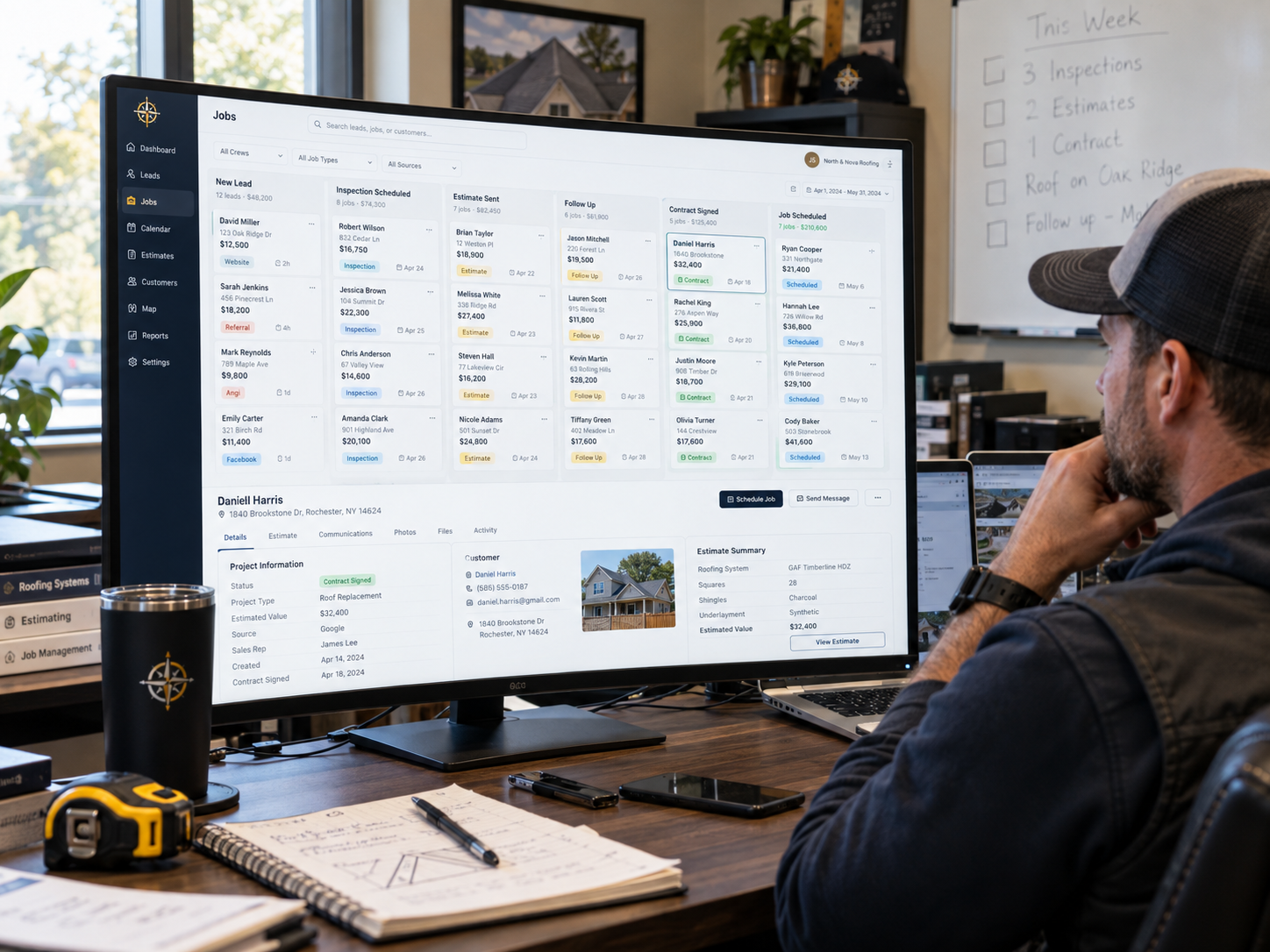
- Visual sales pipeline with dollar values per stage
- Appointment scheduling for inspections and quotes
- Customer updates via automated SMS milestones
- Job status tracking from tear-off to final cleanup
- Review requests sent automatically upon completion
- Reporting on win rates, cycle times, and rep activity
Roofing Marketing
- Local SEO for roofing contractors in your territory
- Google Business Profile management and weekly posting
- Smart roofing website designed for mobile estimate requests
- Lead generation from high-intent search terms
- Review generation that builds 5-star Google momentum
- Search visibility in local Google 3-Pack rankings
- Conversion tracking from phone call to booked estimate
- Lead source reporting that exposes where signed jobs come from
Roofing CRM Software Built Around Your Sales Process
Your roofing CRM should tell your team who needs attention, what stage every opportunity is in, and what happens next.
New Lead
Captured in seconds
Inspection Scheduled
Calendar locked
Estimate Sent
Digital + photo-backed
Follow-Up
Auto-chased days 2, 5, 9
Contract Signed
E-sign on mobile
Job Scheduled
Crew dispatch ready
Completed
Final walk-through
Review Requested
SMS sent within 2 hrs
Roofing Sales Pipeline Tracking
Track every residential, commercial, insurance, and referral opportunity through a defined sales process with live contract values.
Automated Estimate Follow-Up
When an estimate goes out, follow-up doesn't depend on someone remembering to make another call three days later. Automated SMS and email sequences keep you in front of the homeowner until they sign or pass.
Customer Communication
Keep homeowners informed when inspections are scheduled, estimates are ready, jobs are delayed, crews are arriving, or work is complete.
Roofing Review Requests
Completed jobs automatically trigger a review request while the experience is still fresh, driving steady 5-star Google review growth.
Roofing Estimating and Quoting Software That Keeps Follow-Up Attached
Getting the estimate out is only half the process. The real problem starts when nobody knows which estimates need attention.
Inspection → Estimate → Follow-Up → Approval → Scheduling
Your roofing system tracks estimate amount, date sent, salesperson, status, next action, customer responses, follow-up attempts, and close outcome in one place.

CRM Workflows for Insurance Restoration Roofing
Storm and insurance work creates a different sales process from retail roofing. A restoration job might involve:
Your CRM should reflect that instead of forcing every roofing opportunity into the same pipeline. We set up dedicated stages for claim status, adjuster details, homeowner follow-up, document reminders, inspection dates, supplements, job status, and communication history so insurance files never stall in limbo.
Roofing Marketing That Connects to the Sales Process
Getting more roofing leads only matters if your business knows where they came from, responds quickly, follows up, and can tell which channels are actually producing signed work.
Local SEO for Roofers
Improve the pages, local signals, service-area content, reviews, and technical factors that affect local search visibility.
Google Business Profile
Keep services, categories, job photos, reviews, and local landing pages aligned around the territory you're trying to win.
Roofing Website Design
Build pages around actual roofing services and buyer searches instead of sending every visitor to a generic home page.
Roofing Lead Tracking
Connect calls, forms, campaigns, and opportunities so you see where roofing leads originate and what happens afterward.

How Roofing Companies Turn Search Traffic Into Roofing Leads
North & Nova connects the marketing side to the sales side so you can see more than traffic and form submissions. You can see which inquiries became estimates and which estimates became signed work.
Shelter Guard Roofing & Gutters
Leads, estimates, follow-up, online visibility, and customer communication were operating in separate places. Things were getting dropped when crews were in the field.
CRM pipeline, lead assignment, customer communication, automated review process, Google Business Profile work, local service pages, website improvements, tracking and reporting.
The team can now see where each lead sits, what happened previously, and what action needs to happen next. No more relying on memory or buried texts.
"North & Nova Systems helped us get organized fast. We were juggling leads, follow-up, and day-to-day operations, and they brought structure to the whole thing."
Unified CRM Pipeline, Google 3-Pack SEO & Automated Review Follow-Up
Do You Need a New Roofing CRM or Better Use of the One You Already Have?
North & Nova isn't tied to replacing JobNimbus, AccuLynx, or another roofing platform simply to sell you different software. If your current system handles production well, we can work around it and fix the parts where leads, customer communication, marketing, and follow-up break down.
| Your Current Situation | The Better Move |
|---|---|
| Current CRM works fine but nobody actually follows the process | Fix the workflow and automated triggers so steps happen without babysitting |
| Leads aren't being followed up and quotes go cold | Build automated SMS and email follow-up on days 2, 5, and 9 |
| Salespeople can't see opportunity status or dollar values | Build a visual pipeline stage view so deals never hide in someone's head |
| Production requires deeper roofing-specific takeoff tools | Keep your roofing takeoff platform and connect the lead and follow-up front end |
| You're paying heavy per-seat fees for features nobody touches | Simplify the setup around what your team actually uses every day |
| Marketing data stops at 'lead generated' with no revenue connection | Connect marketing sources directly to CRM pipeline outcomes and closed jobs |
Get Found. Capture Inquiries. Follow Up Estimates. Win More Roofs.
Talk through how leads, estimates, follow-up, and reviews run in your business today. We'll show you exactly where work is leaking and how to fix it.
No obligation. Free 15-minute review.
Roofing marketing & CRM in your city
We tune every roofing system to the specific city and search behavior of its homeowners. See how our roofing revenue systems work in each local market:
Roofing CRM & Marketing Systems FAQ
Direct answers to the questions roofing contractors ask before choosing a system.
The best roofing CRM depends on how your company sells and delivers work. A residential retail roofer may need strong lead tracking, estimate follow-up, scheduling, and customer communication. An insurance restoration company may need claim tracking, adjuster stages, supplements, and production management. North & Nova builds the customer acquisition and sales system around the way your roofing business already operates.
Yes. Follow-up can be triggered when an estimate is sent and continue based on timing, customer responses, and opportunity status. Sequences chase the bid on days 2, 5, and 10, so high-ticket quotes stop going cold while your crew is out in the field.
Yes. If your existing roofing software handles production or estimating well, replacing it may not make sense. The rest of your lead, follow-up, customer communication, and marketing process can often be built around it.
Yes. Calls, forms, landing pages, website inquiries, and other lead sources can feed into your sales process based on how your system is configured. Every lead gets tagged with its source so you know which channel generated the quote.
Yes. Opportunities move through clear visual stages such as new lead, inspection scheduled, estimate sent, follow-up, contract signed, job scheduled, and completed. The owner sees dollar value in each column and which quotes need attention.
Yes. Completed jobs can trigger review requests and reminders by SMS while the homeowner is still excited about their new roof. Every customer gets the same direct link, with private feedback alerts sent to you if an issue comes up.
Yes. North & Nova works on service pages, local landing pages, Google Business Profiles, reviews, technical site issues, and other factors that affect local visibility so you show up in the local 3-Pack when homeowners search for roofers nearby.
Yes. Roofing websites are built around individual services (replacement, repair, metal, flat, gutters), service areas, customer actions, and search demand rather than acting as a static digital brochure.
Want to see how this plays out in the field? Read the latest notes and breakdowns on the blog.
Ready to see which systems your shop is missing?
In 15 minutes, we review your current website, Google profile, lead follow-up, and point out the leaks where money is falling through the cracks.