Automated Email & SMS Marketing with Lead Follow-Up Automation
Follow-up that runs itself, season after season

Email & SMS Marketing
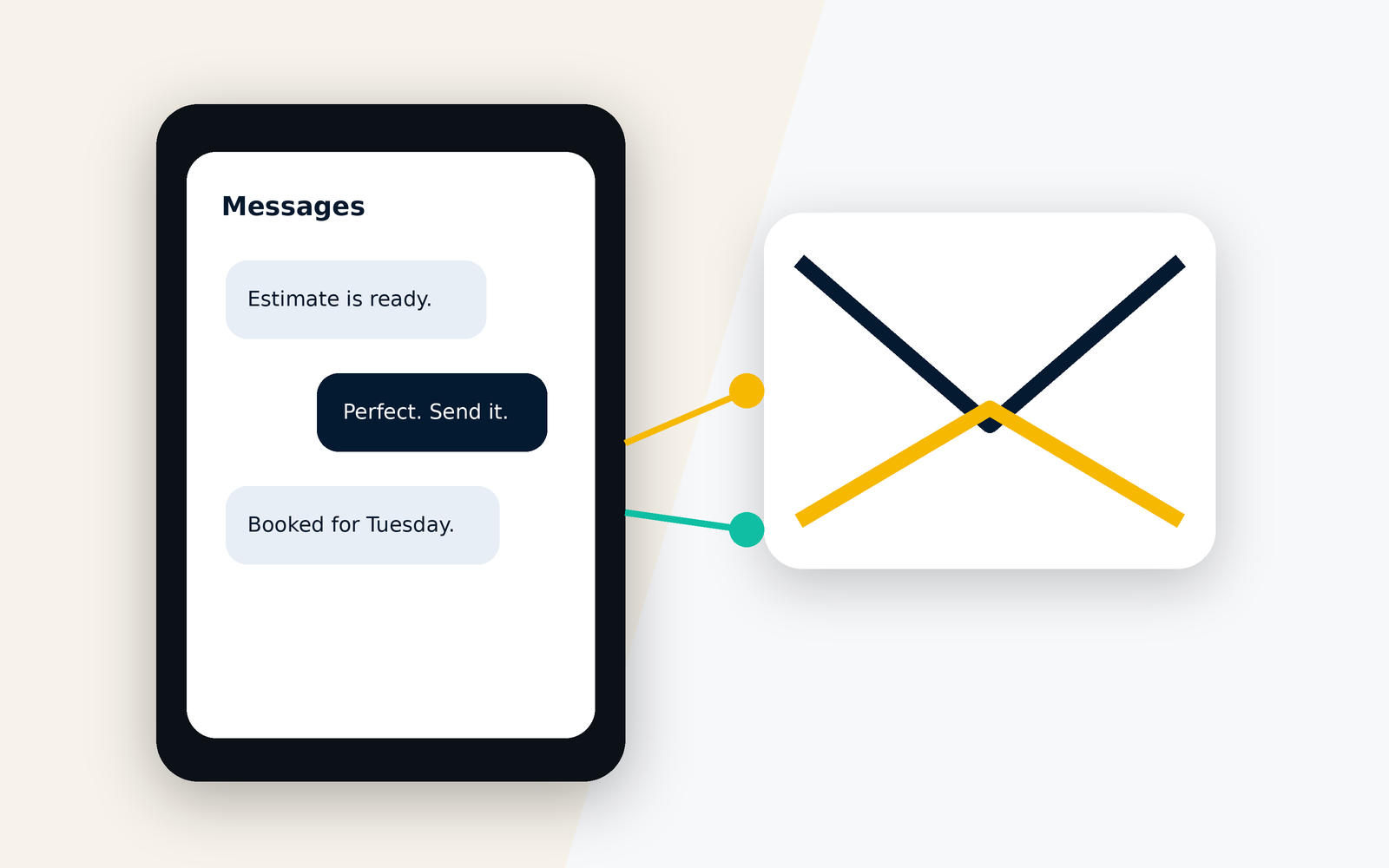
Automated email and SMS marketing with lead follow-up automation for small businesses. Re-engage past customers, promote seasonal tune-ups, and chase unpaid invoices without you lifting a finger. Combined with a unified inbox for every channel.
How We Build & Run This System
We start by looking at how work moves through your business today: where inquiries come in, how fast they get answered, what happens to a quote after it goes out, and where jobs stall. Then we replace the manual steps that depend on you with automated ones that do not.
Every piece is set up around your real service areas, your trade, your pricing, and your schedule. We handle the technical setup, the carrier registration for business texting, the dispatch calendar, and the review campaigns so your team can stay on the work in the field.
Once it is running, you can see where every lead came from, which quotes are sitting open, and where revenue is being lost. That visibility is what lets you fix the next leak instead of guessing at it.
Past customers buy again on autopilot and invoices get paid without awkward phone calls.
Go deeper on follow-up
Automated email and SMS follow-up is one piece of the full system. It is how a trade shop keeps past customers buying and invoices getting paid. revenue operating system for trade businesses ties it together.
Explore the operating system Pricingsee the retainer tiers to compare Foundation, Growth, and Command.
See the retainer tiers Go DeeperWhat is A2P 10DLC?. Why your business texts need a registered number or they get filtered as spam.
Read moreLead Follow-Up Automation & Email SMS Marketing
Direct answers about automating your follow-up.
The best way to follow up with leads automatically is to set up an SMS and email sequence that triggers the moment a lead enters your CRM, then fires follow-up messages on a schedule until the lead books or passes. North & Nova's lead follow-up automation sends an instant response, follows up with quote details, and chases the estimate on days 2, 5, and 10, so closing rates stop depending on your memory. The sequence runs from a unified inbox where every reply is tracked in one chronological timeline. See our A2P 10DLC definition for why a registered number is what lets those texts actually land.
To automate follow-up for your service business, connect your lead capture forms and phone system to a CRM that triggers SMS and email sequences automatically. When a homeowner submits a quote request or a missed call comes in, the system sends an instant text, schedules follow-up messages, and logs every interaction in one timeline. North & Nova builds this as part of the complete revenue operating system, so every lead gets followed up whether you are at the desk or on a job site.
Yes. Automated follow-up is especially effective for trade businesses because most shops lose 20 to 30 percent of leads to slow or forgotten follow-up. A sequence that responds instantly and chases quotes on a schedule recovers leads that would otherwise go cold and call a competitor. For HVAC, plumbing, and roofing shops, automated follow-up typically lifts quote close rates by 20 to 30 percent within the first quarter. Pair it with missed call text back and the first touch happens in seconds, not hours.
Lead follow-up automation is software that sends pre-written SMS and email messages to leads on a schedule, without manual effort. When a lead enters your system, the automation fires an instant response, then follows up with reminders and quote details over the following days until the lead books or passes. It works by connecting your lead capture, CRM, and messaging channels so every lead gets a consistent, timely follow-up regardless of how busy you are.
The best appointment scheduling software for contractors is one that syncs directly to your live dispatch calendar, sends automated SMS reminders to cut no-shows, and lets homeowners self-book 24/7. North & Nova's appointment scheduling software for contractors supports multiple technicians, arrival window reminders, and priority routing for emergency calls, so your crews show up to homes where someone is actually there and your calendar stays full without phone tag. Our smart website puts that calendar right on the page so visitors book without calling.
Yes. Text-to-pay for contractors sends a payment link by SMS the moment a job is marked complete, so the customer can pay with a tap from their phone without you mailing an invoice or making an awkward follow-up call. North & Nova builds text-to-pay into the operating system alongside invoicing and the CRM pipeline, so a booked job flows straight through to a paid invoice and your collection cycle shrinks from weeks to days.
Job pipeline tracking software gives you a visual board where every job moves through stages, from new lead to estimate sent to scheduled to completed to paid, so nothing stalls without you seeing it. For a trade shop, it means you can spot the quote that has sat open for two weeks or the job that never got invoiced. North & Nova's job pipeline tracking software ties each stage to automated follow-up, so an estimate that goes cold triggers a chase sequence and a completed job triggers a text-to-pay request automatically. Read our lead pipeline definition for how the stages work.
Workflow automation software for contractors connects the steps in your business, when a job is booked, schedule the crew and send a confirmation text; when a job is complete, request a review and fire a text-to-pay link; when a quote goes cold, chase it on a schedule. North & Nova builds these workflows so the owner does not have to remember each trigger. The result is a business process automation system for home services where revenue-generating steps happen on their own, whether you are at the desk or on a job site. See the full retainer tiers for what is included.
Ready to see which systems your shop is missing?
In 15 minutes, we review your current website, Google profile, lead follow-up, and point out the leaks where money is falling through the cracks.