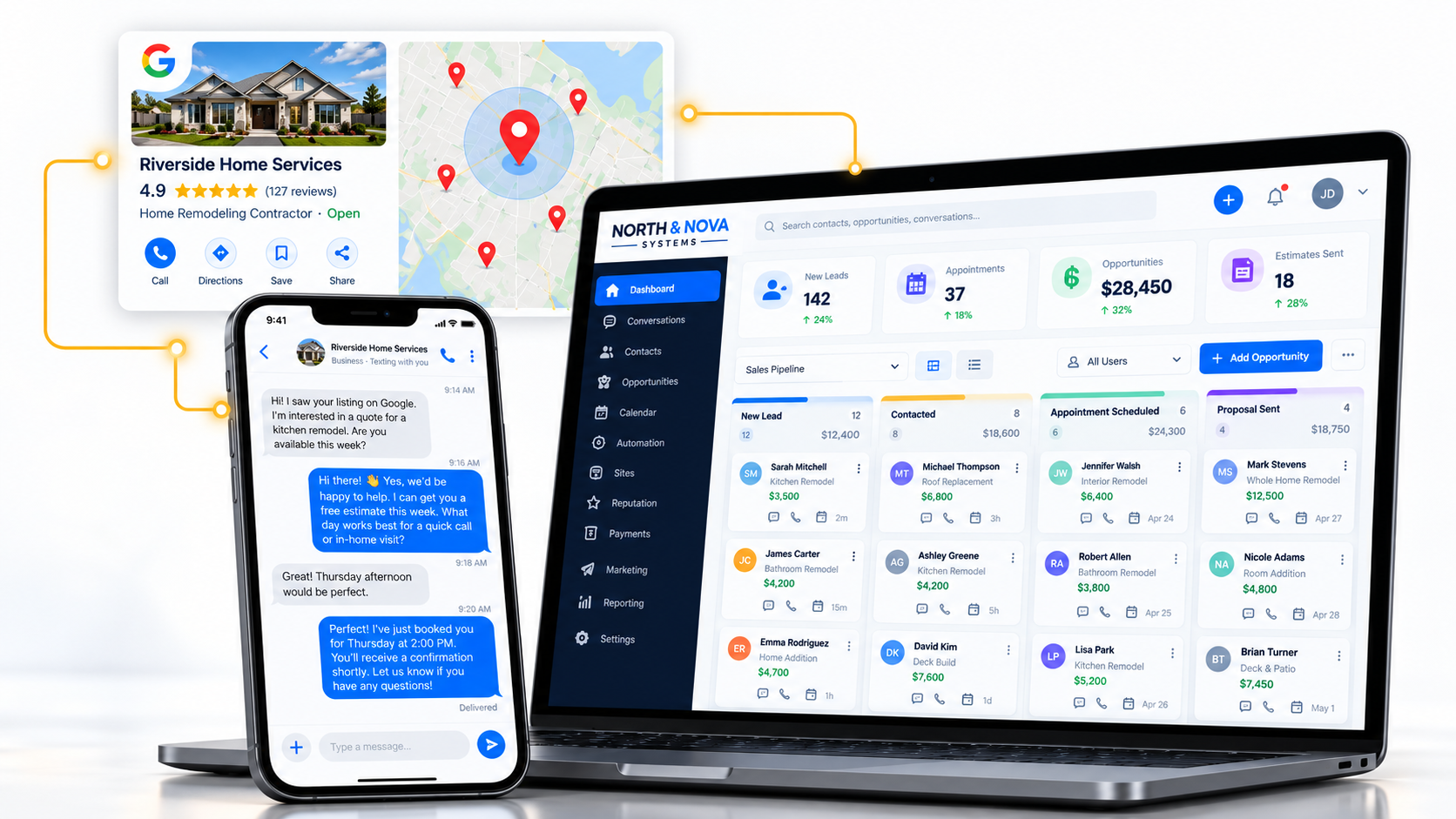
No round-number claims and no logos we borrowed from somebody else’s wall. These are three home service companies we work with, what was broken when we started, and what the number looked like after.
Ryan had a crew, equipment, and a reputation in the towns he worked. What he didn’t have was any way for a stranger to find him. No website. Nothing that came up when somebody in his service area typed “landscaping near me” into their phone.
Every job came from word of mouth or somebody spotting the truck. That works until you want to grow, and then it caps you at the size of the circle that already knows you.
A real site that says plainly what he does and, just as importantly, where he does it. Search engines can’t match you to a town you never mention.
Then the Google Business Profile: claimed, filled out properly, services listed, service area set, hours right, photos of actual work instead of stock images.
Nothing exotic. The reason it worked fast is that nothing was there before it.
Inside 60 days he was on page one of Google for landscaping searches in his area, starting from no web presence at all.
The honest part: going from zero to something is the easiest gain in search. There was no competition for the spot he was filling, because he wasn’t competing for it yet. Holding page one and expanding into more towns is slower and harder work.
“My online setup finally looks like the quality we put on the ground, and the calls coming in show people noticed.”
Dan runs a shop that has done good work for years. The review count didn’t say that. It said what most shop review counts say, which is that asking for a review was somebody’s job at the counter and that person was busy.
There was a second leak. A missed call at a tire shop isn’t a voicemail, it’s a customer already dialing the next shop on the list.
The review ask stopped being a person’s job. When a ticket closes, the customer gets a text with a direct link to the review page. It goes out the same way every time, whether the shop is slammed or empty.
Every customer gets asked. There’s no survey in front of it deciding who’s happy enough to be sent to Google. That filtering is against Google’s policy and it’s the kind of thing the FTC has gone after. We don’t build it, on any account.
We added missed-call text back at the same time. If the phone rings out, the caller gets a text within seconds.
50 Google reviews in 40 days.
Reviews are the tiebreaker in local search. Two shops, same distance from the customer, same price range. The one with recent reviews gets the call. Recency matters as much as the count, which is why an automated ask beats a review push that happens once and then stops.
“A missed call used to mean the customer just drove to the next shop. Now they get a text back before they leave the parking lot, and we book the work.”
James and Maui were doing solid roofing and gutter work and barely turning up in the towns they wanted it in. The problem wasn’t the work or the crew. It was that the online side of the business didn’t reflect either one.
A site built to turn a visit into a conversation, not just to look good on a laptop. Services stated clearly, service areas named, phone number tappable on a phone, and a form that lands in the CRM instead of an inbox nobody checks on a Saturday.
Behind it, the same follow-up structure: a new lead gets a response fast, and a missed call gets a text back.
Under 60 days from launch: 400 visits, 20 new leads.
That’s one lead for every twenty people who landed on the site. For a roofing company at the start of a season, twenty conversations is a real number, and it came out of traffic most people would call small.
The honest part: 400 visits is a starting point, not a finish line. The conversion rate is the thing worth protecting as the traffic grows.
“We were doing good work but barely showing up in the towns we wanted it in. They fixed the stuff under the hood, and now we turn up where the jobs are.”
Three different trades, three different states, three different problems. Not one of them fixed it by buying more leads. Each one had a specific point where work was leaking out of the business, and we fixed that point.
Ryan couldn’t be found. Dan could be found but didn’t have the proof to win the tiebreaker. James could be found and had the proof, but the site wasn’t turning visits into conversations. Same five points of control, three different breaks.
That’s the whole argument for finding your weak point before you spend a dollar on more traffic. The full breakdown lives on the Service Business Operating System page.
These are early results from short windows. Forty days, sixty days. That’s long enough to show a system started working and too short to call it a trend. Anybody showing you a 40-day number and implying it runs forever is selling you something.
Three companies also isn’t a sample. It’s three companies. Your trade, your market, your competition, and how much of a head start the shop down the road has will all change what your first sixty days look like.
What these do show is what happens when you find the one point that’s leaking and close it, instead of doing a little bit of everything at once. That part carries over.
Free 15-minute system review. No pitch. Just clarity.
We build the systems that keep your business running when you step away.
Free 15-minute call. No pitch, just a look at what's slowing you down.